Lol. I am starting this with that because I listened to the episode again and I just couldn’t help but laugh. I sounded so angry.
The funny thing is that I wasn’t even angry when I recorded it, so I honestly don’t know why my voice came across that way. If you don’t understand what I mean, listen to my other episodes and you’ll notice that my voice is usually much brighter than it sounds in this one.
The first recording I did for this episode was completely different. I wasn’t even thinking. I was simply speaking from the heart after seeing something online that triggered me to press record. A few days later, I listened to it again and realised it wasn’t worth releasing, so I deleted it.
Most of the points from that original recording still made it into this episode because they are true to what I believe. That’s true, even if it means disappointing strangers on the internet.
I hope you enjoy the episode.
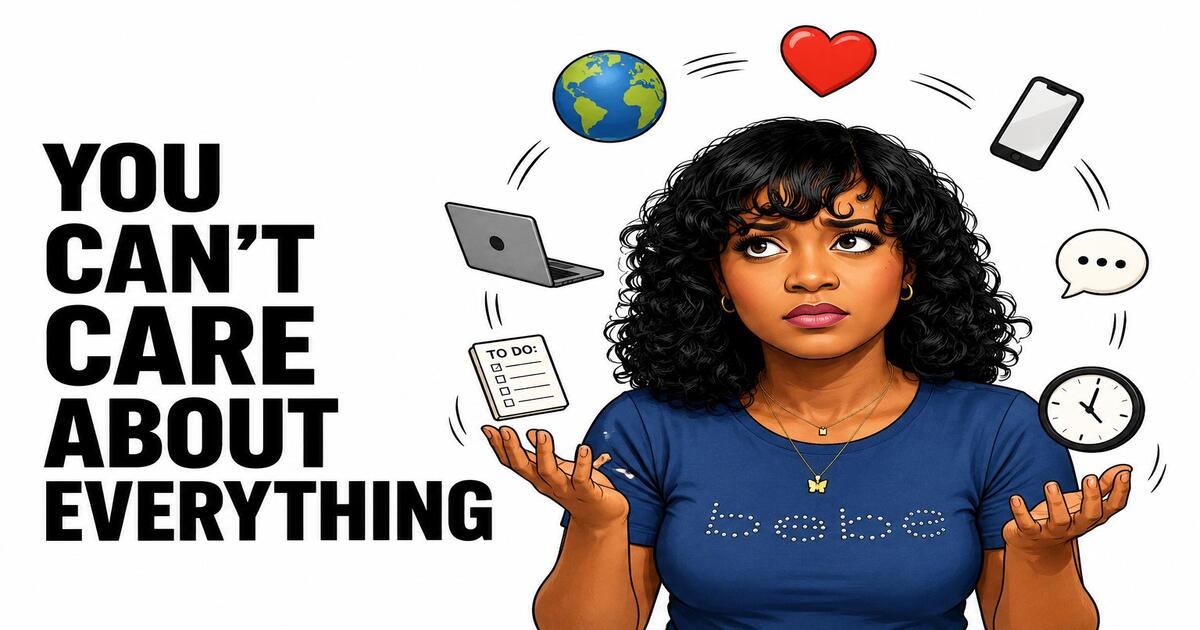
You cannot care about everyone and everything with the same level of intensity, and trying to do so only leaves you overwhelmed and ineffective. In this episode, I talk about the importance of choosing your battles, especially in a world where social media constantly demands your attention and emotional energy.
I also explore the double standards, prejudices and biases that all of us carry, even when we don’t realise it. Using everyday examples, I reflect on why some behaviours are judged differently depending on who is involved, how personal experiences shape our biases, and why self awareness is necessary if we want to become better people.
Finally, I share a simple personal experience that made me realise how easily we can subconsciously condition ourselves. The encouraging part is that if we can unintentionally condition ourselves into certain habits, we can also intentionally condition ourselves into better ones.
You can’t care for everyone and everything at the same time, with the same level of intensity. I am Nessa Hagoz, this is Bathroom Musings episode 9. We live in a world that tries to force you to care about every single cause, and it’s not possible. You need to pick your battles.
You go on the internet and this group is talking about, oh we need to do this, and this other group is over here doing this, and then that other group, and you’re so overwhelmed, and you’re so confused, and you’re like here, here, here, here, here, and you can’t even make a significant change in your own world because you’re spread so thin. That’s the trap of caring about every single thing happening in the world. Another thing too is being so invested in something you can’t control.
I am a Nigerian and there’s a lot that’s happening in Nigeria, right? It would be very senseless of me to start worrying about a war going on somewhere. When people in my country are kidnapped, the terrorism is just devastating, the government isn’t doing anything about it, you can’t go put out your neighbour’s fires when your house is on fire. It doesn’t work that way.
Charity, they say, begins at home, but we’ve forgotten that. People want to castigate you and be like, why are you not tweeting, or why are you not talking about this thing happening here, and I’m like, excuse you, so I should leave what’s happening in this country and start talking about what’s happening somewhere else. I care about what’s happening there, but this is closer to home.
It’s very important that you don’t fall into the trap of trying to please strangers on the internet, that you lose your focus, you lose yourself. Talking about the internet, there’s also this thing of double standards as well. Double standards, prejudices, and biases, we all have it.
There’s this thing, the holier-than-thou attitude, the I am more attitude. Sadly, we all have it, even yours truly. But you think that you are more enlightened, you are better than a person because of the level of enlightenment you have.
I checked out a show, and the female judge was this male contestant who was so handsome, and the female judge was like, oh, you’re so cute, and stuff like that. And the guy smiled, and the way the female judge was looking at the guy, you could tell that she found him really attractive, and the guy was reciprocating as well. And people were like, oh, that’s so cute, she likes him, and stuff like that.
And everyone thought it was cute, right? But I was thinking about it, and I thought to myself, if it was a guy, a male judge, doing that to a female contestant, everyone would call for him to resign, or call him perverse, or stuff like that. And the question is, why do we have double standards? Because we have double standards. Well, there are three reasons for this type of behaviour happening.
Number one is power dynamics. 90% of that female who is leering at a male stranger can’t really hurt him, can’t really sexually abuse him. 90%, right? But if it’s a male doing the leering to the opposite gender, 60% of the time he could act on it, maybe violently, or in a way that would make the lady uncomfortable.
That’s why. That’s number one. Secondly also is history.
History has shown that when a man is in the leering, it could lead to danger, and so the woman is definitely uncomfortable. But we really don’t have so much evidence that when it’s a woman doing it, it’s more on the male side. The level of hurt that could be done is more on the male side, if it’s the man doing the leering, than it is on the female side, if it’s the one doing the leering, based on history.
That’s number two. So that’s why we have these double standards. Would they ever change? I don’t know.
Never say never, yeah? Now, apart from double standards, there’s also this thing called prejudices and biases as well. And sincerely, we all have it. We all have it.
You might want to think you don’t, but you do. I was thinking about it. I was asking myself, what are my prejudices? What are my biases? And I asked myself, if someone from a particular place asked, like, wanting to be romantically involved with me, would I give them a chance? I don’t know this person.
I’m not seeing any face, no picture, no nothing. They all say, this person is from this place. Would you give them a chance? And I thought of one place, and I’m like, nope.
So why wouldn’t I give them a chance? Well, because of what I’ve heard about people from that place. Well, that’s a prejudice, that’s a bias, because you really don’t know this person. We’re all like that.
We all have these prejudices and biases. And being a Nigerian, it’s pretty annoying when someone doesn’t give you a chance, they won’t even let you talk, or they won’t want to further the conversation. I’m not talking about romantically speaking, I’m talking about other areas of life.
They won’t want to talk to you or give you the time of day, simply because you’re Nigerian, and that’s equal to scamming. And sometimes you won’t even blame these people, because that’s the general perception of people from this place. And the Nigerians that I’ve met online sometimes aren’t even helping matters, they boast about scamming people, they sing about it, they talk about it, it’s funny.
But by doing that, you’re also spreading a wrong message about the people from that country. So we all have it, and I think it takes a level of self-awareness to just tell yourself, okay, these are my prejudices and my biases. How do I deconstruct this, break it down, and at least in this area be less biassed and be a better human being? So that’s that one about prejudices, biases, and double standards.
So the question is, what are your double standards? Or what double standards have you seen in the world that people don’t really blink an eye, concerning, but it’s actually there? And what are your prejudices and biases? And you know the thing about double standards is that sometimes, because it’s so subtle, it’s not a neat thing until it becomes a thing that can’t be controlled. Biases and prejudices sometimes come from personal experience. If a woman, for example, was abused by men from when she was small till she was maybe 18, 19, 20, and then maybe later she was still abused by men, I’m not saying it’s okay, please don’t misunderstand, but I’m saying it’s understandable if she has a certain bias or prejudice against men.
Now the problem is when it becomes overwhelming, I think, how you really can’t blame her. And same thing too, like you really can’t blame the person. Now I’m not saying it’s good, but I’m saying understanding as well, right? But then the question is, if it was a man that had this kind of bias or prejudice against women, we’d call him what? Misogynistic.
We don’t want to, we don’t give two hoots about his background or what he’s been through. We just say, no, you’re very misogynistic. Don’t think of women like that.
Grow up. You’re not still a child. Why can’t we give the same level of understanding and grace to the other party? Why? Why? That’s another thing I don’t really like about double standards, is this other party gets leeway, they get the grace, but we can’t extend that same grace to the other party.
We can’t extend the same level of understanding to the other party because they should be better, they should know better, they should be stronger. I don’t know. And I’m not just talking about men or women in this situation, I’m talking about different parties, whatever you want to think of at all, anything.
Why? Why? So that’s that one. And when I was thinking about all of this, I also thought about conditioning. Because they all tie.
When we have these double standards and these prejudices and biases, they’re in a way, in a sense, they’re all conditioning. So I was somewhere and someone gave me something to eat, to munch on, just snacks. And there are two packs of that stuff.
So I ate the first pack and I was full. So I drank water. But while I was eating the first pack and I was getting very full, I started mentally prepping myself and mentally prompting and pumping myself to be like, okay, we’re gonna try our best to finish the second one.
At a point, I had to stop. I was like, but no one is actually making me eat the second one. I don’t have to eat it.
It’s not a big deal. I could always skip it for later. And that was what I did.
But when I thought about it, I was really amazed and in awe. I was like, wow. So this is the way I think.
I have this thing that when someone gives me something to eat, I have to finish it. Because there was a time when I wasn’t feeling too well and I was at home and they would serve me meals. No, they would serve me meals and I would force myself to finish eating everything.
Because number one, I’m like, there’s no way you guys are going to take this food and put it back in the pot. Now, the second thing would be to keep it somewhere and then warm it later and then give it to me to eat. And I’m like, oh, I don’t want that.
I don’t want the food to be taken, kept somewhere and then warmed and given back to me later. I’m like, nope. Then the third thing would be to throw it away.
And I’m like, nope, anti-waste. So the solution for me then was to just eat everything. No matter how full I was, I would just force myself to finish everything.
And I didn’t know that I was subconsciously conditioning myself to always finish my food. No one forced me to do this. I took the decision myself.
So when I was given snacks that were in packs that couldn’t be contaminated or anything, I still found myself trying to force myself to finish both of them. And I was truly amazed. I’m not joking.
I was so amazed. I was in awe. I was like, wow.
It’s so fascinating. Conditioning, it’s so fascinating how we could even subconsciously condition ourselves to a certain kind of life without even, of course, because we don’t know about it, why it’s subconscious. Now, this is good news.
So it means that you can actually condition yourself to have a certain character you want to have. You just have to be willing to reinforce the habit every single time. And I think that’s it.
But it’s also something you need to look out for, watch out for when you consume content, when you talk to people that cannot be subconsciously conditioned. And that’s where generally around good self-awareness cons, where reading good books and talking to reasonable people play a role as well. So think about it.
Maybe this week, try to be more self-aware and ask yourself, in what area am I being conditioned? Because it’s happening always. Trust me. These advertisers, these social media companies, they’re not playing.
Your feed is not playing. All these things, the algorithm, all these things are trying to condition you into a pattern, into a particular way of thinking. So you need to be very, very watchful.
All right. Yeah. Okay.
So this was an episode of me speaking my heart. I just wanted to please record, press record and talk. I didn’t even talk about my book in this.
But yeah. Actually, thank you for listening. Please do share with your friends.
And until next time, see ya.